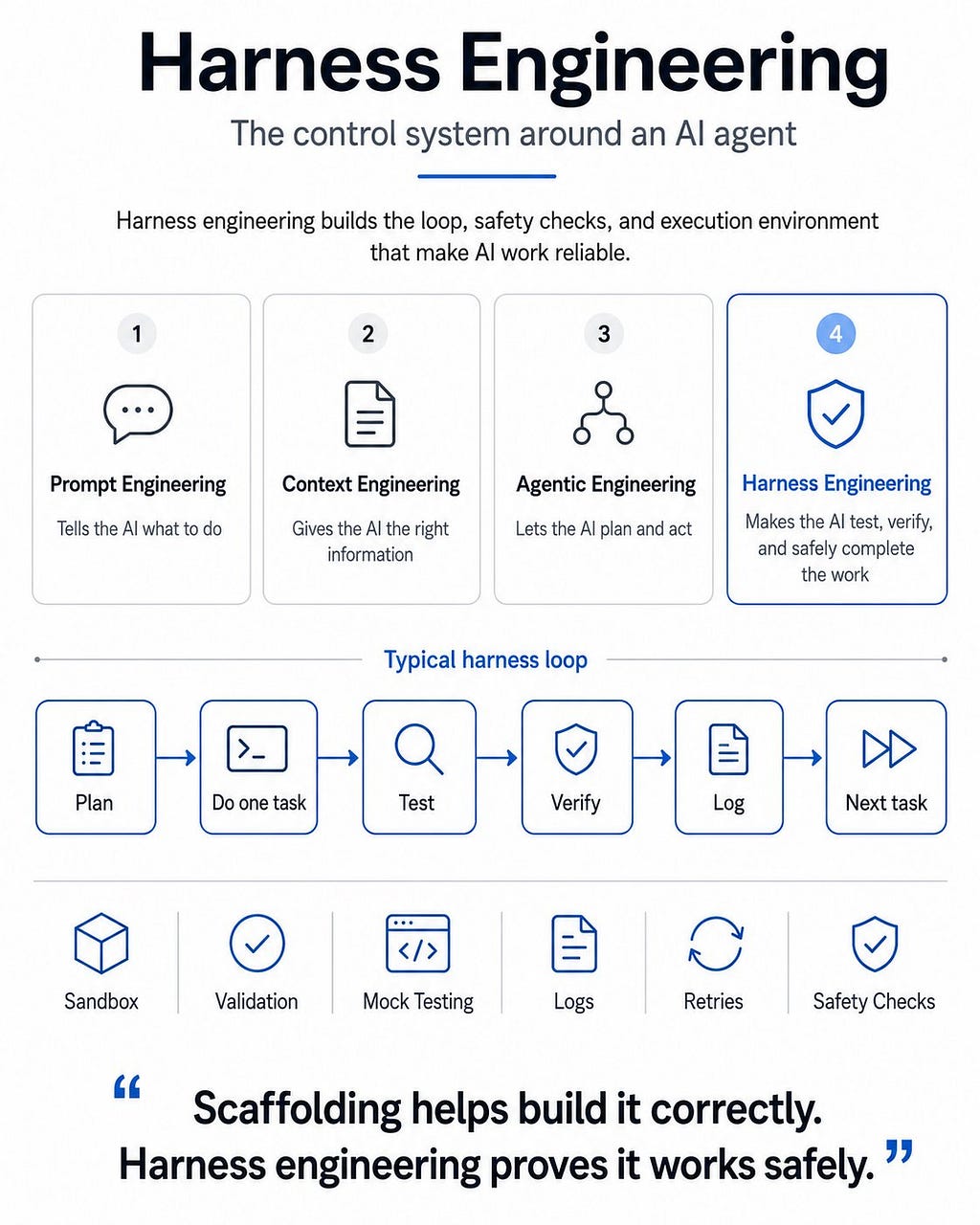
AI development is moving through clear phases.
2023: Prompt Engineering — telling AI what to do
2024: Context Engineering — giving AI the right information
2025: Agentic Engineering — letting AI plan and act
2026: Harness Engineering — making AI prove the work is safe and correct
A large language model by itself is just raw intelligence. It can answer questions, write code, summarize text, or reason through a problem. But on its own, it is still only an API call. You give it tokens, and it gives back tokens.
To make it useful in the real world, we need to put a system around it.
That system is the harness.
A harness gives the AI tools, context, permissions, memory, execution rules, test runners, logs, safety checks, and verification loops. It turns the model from a smart chatbot into a working agent.
This is why the same model can feel very different in different tools. A model inside Claude Code, Cursor, Codex, GitHub Copilot, or a custom company agent may behave differently because the harness around the model is different. The model is only one part of the experience. The harness decides how the model sees files, calls tools, runs commands, manages context, asks permission, tests output, and completes work.
Prompt engineering is still useful, but it only tells the AI what to do.
Context engineering is also important, because it gives the AI the right files, docs, database results, or project information at the right time.
Agentic engineering lets the AI take action using tools.
But harness engineering goes one level above all of this. It controls the full workflow.
A good harness does not simply ask the AI to “build a feature.” It puts the AI inside a loop:
Plan → Do one task → Test → Verify → Log → Move to the next task
This loop matters because long-running AI tasks often fail silently. The agent may assume something is finished when it is not. It may skip testing. It may forget earlier decisions after context summarization. It may produce a half-working feature where some buttons work and some do not.
Harness engineering reduces this problem by making the AI work in controlled steps.
For example, in a coding workflow, a harness can force the agent to:
- read the requirement
- break it into smaller tasks
- pick one task at a time
- edit the code
- run tests
- verify the output
- log the result
- continue only after checks pass
This is not just automation. It is controlled execution.
In OpenAlgo terms, if we use a SKILL.md to guide an AI agent on how to integrate a new broker, that is scaffolding. It helps the agent understand the folder structure, API format, order parameters, websocket rules, safety checklist, and coding conventions.
But the broker test suite, mock broker API, sandbox mode, order validation, websocket replay tests, CI checks, logging, and live-order safety blocks are harness engineering.
That is the key difference:
Scaffolding helps build it correctly.
Harness engineering proves it works safely.
This is especially important in trading systems, finance, coding agents, automation tools, and any system where the AI can take real actions. In these areas, we cannot trust output just because it looks correct. The work must be tested, validated, logged, and verified.
A strong harness can include:
- tool calling
- context management
- permission controls
- sandbox execution
- mock testing
- validation rules
- retries
- logs
- human approval
- final verification
This is also why companies may start building their own internal harnesses. General-purpose tools like Cursor, Claude Code, Codex, or Copilot are useful for broad coding tasks. But a company-specific harness can be much more powerful for repeated internal workflows.
For example, a trading platform may need a harness that understands broker APIs, order safety, mock trades, symbol mapping, exchange rules, and strict no-live-order testing. A normal coding agent may not know these rules deeply enough. A custom harness can enforce them.
So harness engineering is not just a buzzword. It is the next layer of AI engineering.
We are moving from asking AI to do work, to building systems that make AI’s work verifiable.
Prompt engineering made AI useful.
Context engineering made AI informed.
Agentic engineering made AI actionable.
Harness engineering makes AI reliable.
