My Obsidian vault has gotten quite messy over time. I’ve been dumping notes without proper frontmatter, tags were all over the place, and some notes didn’t even have proper titles! I needed a way to clean this up without spending hours manually organizing everything.
I’d been playing around with Claude’s API lately, and thought – hey, why not use an LLM to analyze my notes and add proper frontmatter? After all, that’s what these AI models are good at – understanding context and categorizing stuff.
I wrote a small Python script using the llm library (which is pretty neat btw) to do just this. Here’s what it looks like:
import llm
import os
import yaml
import datetime
from pathlib import Path
import re

class ObsidianNoteProcessor:
    def __init__(self, notes_dir, model_name="claude-3.5-sonnet"):
        self.notes_dir = Path(notes_dir)
        self.model = llm.get_model(model_name)

    def extract_existing_frontmatter(self, content):
        """Extract existing frontmatter if present."""
        frontmatter_pattern = r'^---\n(.*?)\n---\n'
        match = re.match(frontmatter_pattern, content, re.DOTALL)

        if match:
            try:
                return yaml.safe_load(match.group(1)), content[match.end():]
            except yaml.YAMLError:
                return {}, content
        return {}, content

    def generate_prompt(self, content):
        """Generate a prompt for the LLM to analyze the note content."""
        return f"""Analyze the following note content and extract/infer the following properties:
1. A clear title (if not present, generate from content)
2. Relevant categories based on the content
3. Appropriate tags (include 'inbox' if content seems draft-like)
4. Status (Draft/In Progress/Complete) based on content completeness
5. Priority (Low/Medium/High) based on content importance
6. A brief description summarizing the content

Note content:
{content}

Return ONLY the YAML frontmatter without any code block markers. Use this exact format (omit fields if not applicable):
title: <title>
category: <category>
tags:
  - tag1
  - tag2
status: <status>
priority: <priority>
description: <description>"""

    def clean_llm_response(self, response_text):
        """Clean up the LLM response to ensure proper YAML."""
        # Remove yaml code block markers if present
        response_text = response_text.strip()
        if response_text.startswith('```yaml'):
            response_text = response_text.split('\n', 1)[1]
        if response_text.endswith('```'):
            response_text = response_text.rsplit('\n', 1)[0]
        return response_text.strip()

    def process_note(self, file_path):
        """Process a single note file."""
        try:
            with open(file_path, 'r', encoding='utf-8') as f:
                content = f.read()

            # Extract existing frontmatter and content
            existing_frontmatter, main_content = self.extract_existing_frontmatter(content)

            # Generate and execute prompt
            response = self.model.prompt(self.generate_prompt(main_content))
            response_text = self.clean_llm_response(response.text())

            try:
                new_frontmatter = yaml.safe_load(response_text)
                if not isinstance(new_frontmatter, dict):
                    print(f"Warning: Invalid response format for {file_path.name}")
                    new_frontmatter = {}
            except yaml.YAMLError as e:
                print(f"YAML parsing error for {file_path.name}")
                print(f"Response text was:\n{response_text}")
                raise e

            # Merge with existing frontmatter, preferring existing values
            merged_frontmatter = {**new_frontmatter, **existing_frontmatter}

            # Add date if not present
            if 'date' not in merged_frontmatter:
                merged_frontmatter['date'] = datetime.date.today().isoformat()

            # Generate new note content
            new_content = "---\n"
            new_content += yaml.dump(merged_frontmatter, sort_keys=False, allow_unicode=True)
            new_content += "---\n\n"
            new_content += main_content.strip()

            # Write back to file
            with open(file_path, 'w', encoding='utf-8') as f:
                f.write(new_content)

            print(f"✓ Processed: {file_path.name}")

        except Exception as e:
            print(f"✗ Error processing {file_path.name}: {str(e)}")

    def process_vault(self):
        """Process all markdown files in the vault."""
        print("Starting Obsidian vault cleanup...")

        for file_path in self.notes_dir.glob('**/*.md'):
            self.process_note(file_path)

        print("\nVault cleanup completed!")

def main():
    # Set up the model key if not already configured
    model = llm.get_model("claude-3.5-sonnet")
    if not hasattr(model, 'key'):
        api_key = os.getenv('ANTHROPIC_API_KEY')
        if not api_key:
            raise ValueError("Please set ANTHROPIC_API_KEY environment variable")
        model.key = api_key

    # Initialize and run the processor
    notes_dir = "/Users/karan/Notes/Obsidian/The Wall/Notes"
    processor = ObsidianNoteProcessor(notes_dir)
    processor.process_vault()

if __name__ == "__main__":
    main()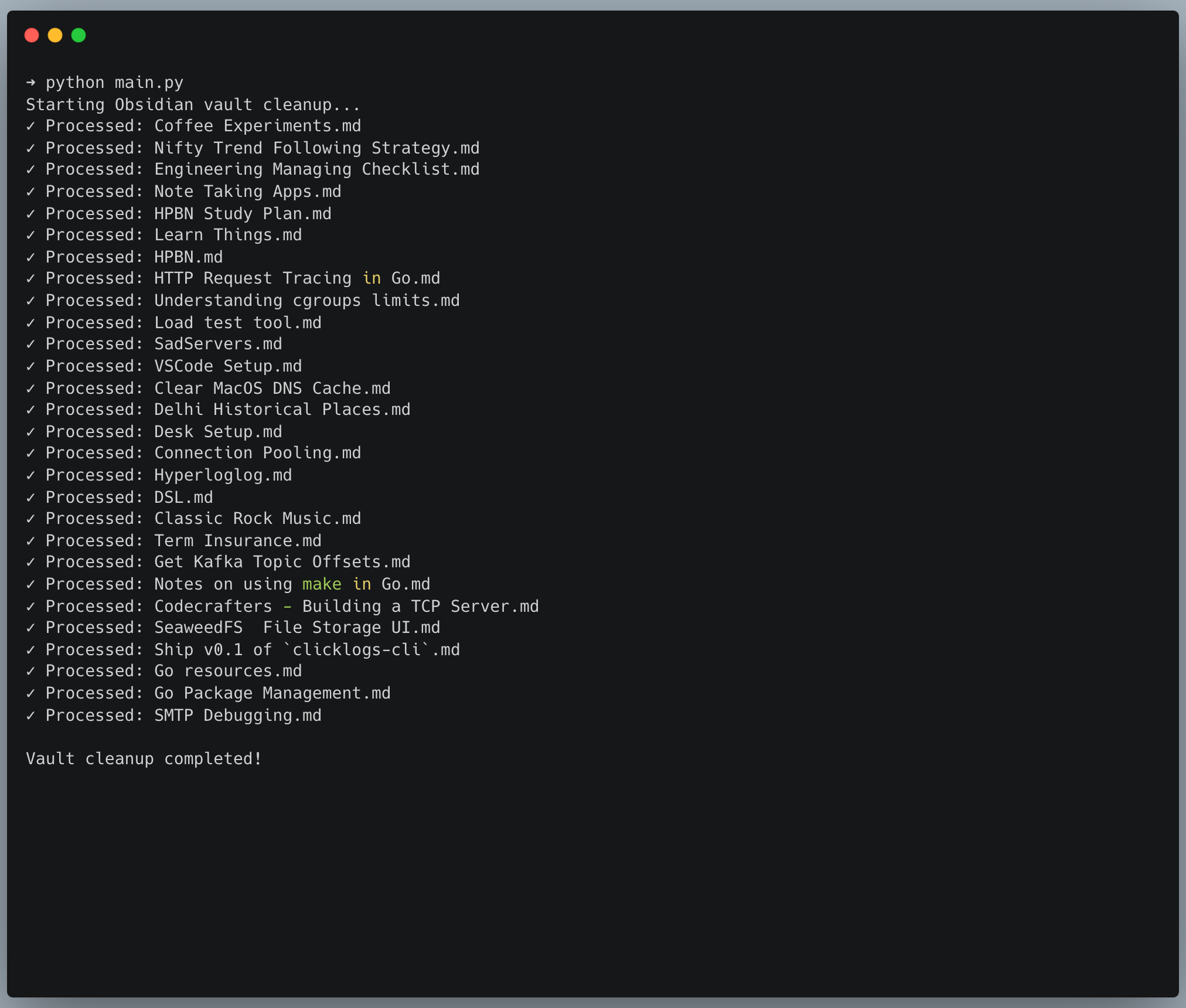
The script is pretty straightforward – it reads each markdown file, extracts any existing frontmatter (because I don’t want to lose that!), and then asks Claude to analyze the content and generate appropriate frontmatter. It adds stuff like title, category, tags, status, priority.
What I love about this approach is that it’s contextual. Unlike regex-based approaches or keyword matching, the LLM actually understands what the note is about and can categorize it properly. A note about “Setting up BTRFS on Arch” automatically gets tagged with “linux”, “filesystem”, “arch” without me having to maintain a predefined list of tags. The categorization is probably better than what I’d have done manually at 2 AM while organizing my notes!
Fin!
