Busting the Common Misconception: Faster Languages, Desktop Apps, and Broker APIs Do Not Automatically Give You Better Execution or High Frequency Performance
Many traders who get into automation believe a few things that sound convincing at first.
They believe that choosing a faster programming language gives them faster execution.
They believe that building a desktop application on top of a broker API is more reliable than a web based application.
They believe that having broker connectivity over the internet means they can do high frequency trading.
All of these beliefs have some truth behind them, but taken alone they create the wrong picture. To understand what really matters, we need to look at what delays your trades, what high frequency trading actually means, and what kind of tools and SDK support you need to build strategies that can grow over time.
What is latency, explained in simple terms for traders
Latency is the time it takes for your order to travel from your system to your broker, then to the exchange, and for the acknowledgement to come back. Think of it like sending someone a message and waiting for their reply, but in milliseconds instead of seconds. Every time you place an order, this round trip happens.
Latency is not just about your program. It includes the time taken by your internet, your broker network, and the exchange itself.
Where the real delay comes from
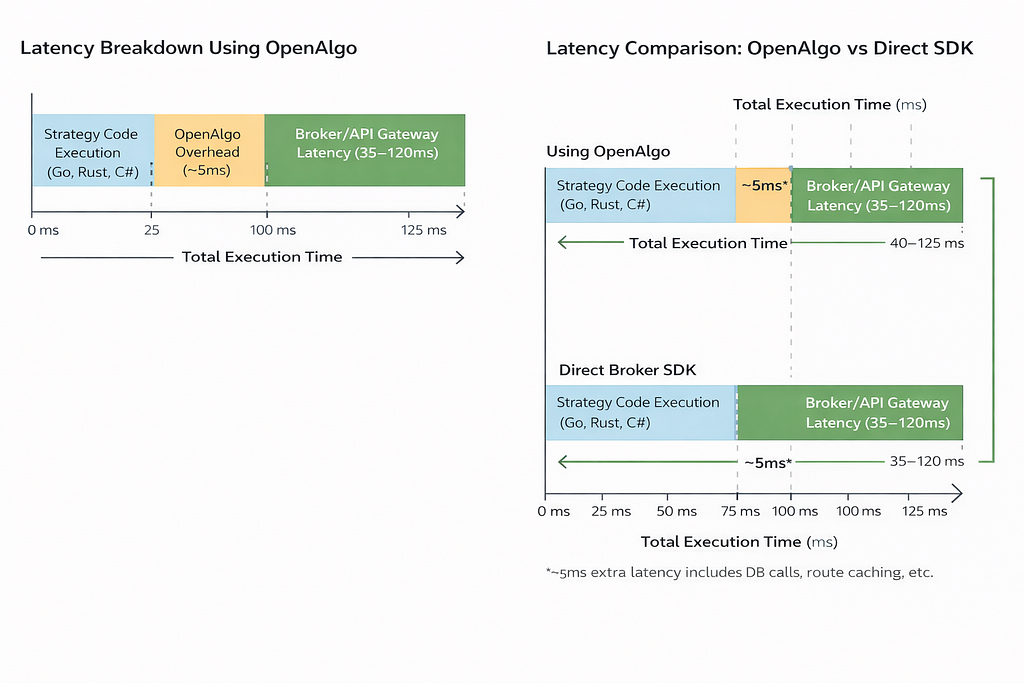
Across most broker platforms, the unavoidable round trip between your system and the broker takes anywhere between thirty five and one hundred twenty milliseconds. This is the largest part of the time spent. Your strategy code itself, whether written in Go, Rust, C Sharp, or Python, usually completes its logic in less than one millisecond.
OpenAlgo adds around five milliseconds because it takes care of routing, caching, and consistent internal checks before your order is sent out.
Put together, the total time looks like this:
Strategy code time         around 0.1 ms
OpenAlgo internal time     around 5 ms
Broker request time        35 to 120 ms
Total                      40 to 125 ms
Removing OpenAlgo would save a few milliseconds, but it would not remove the biggest delay, which is the broker path.
Why many traders cannot do true high frequency trading from home
Many new traders say that a total latency of forty to one hundred twenty milliseconds means they can do high frequency trading. In reality, true high frequency trading takes place at microsecond and nanosecond timings. These strategies do not use the regular internet. They operate inside exchange data centers where the cables between systems are measured in meters and sometimes even centimeters.
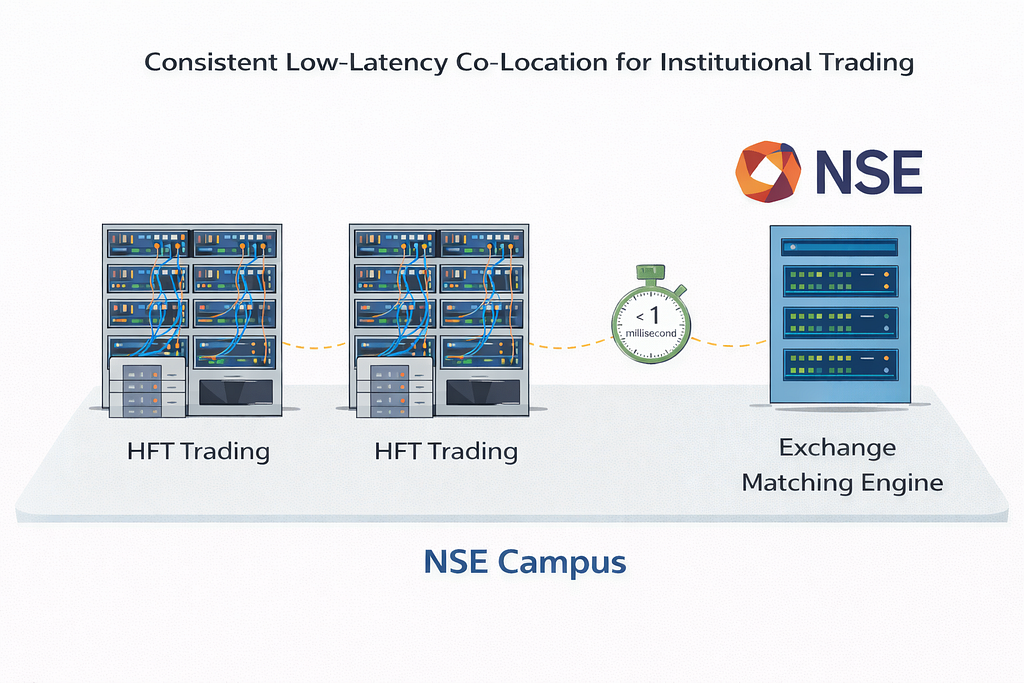
Over home or office internet, latency is not only higher, it is also inconsistent. One order might reach the broker quickly, the next one might take longer because of changing network conditions. For high frequency strategies, consistency matters even more than speed. To get consistent speed, traders colocate their systems inside exchange facilities. That is where true high frequency strategies live. They do not run on a laptop or a desktop at home, and they do not run over regular internet.
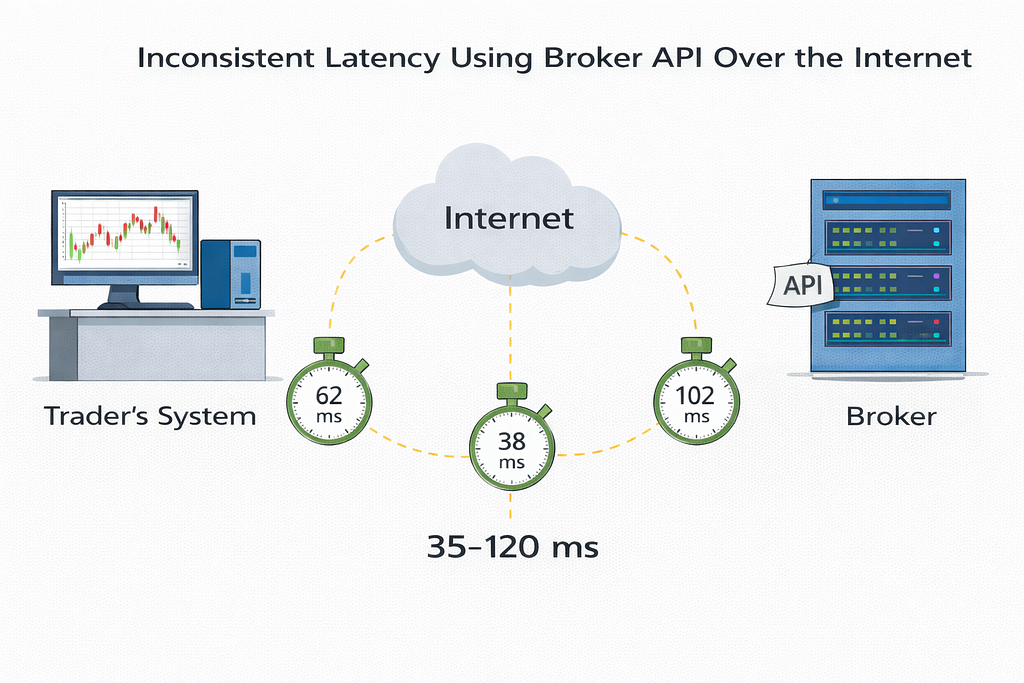
So the myth that high frequency can be done over a standard broker API with internet based round trips is not accurate. To get consistency, you need physical proximity to the exchange and infrastructure designed for it.
The myth of desktop applications being more reliable than web applications
Another common belief is that desktop based applications built on top of broker APIs are more robust than web applications. Traders often assume that a desktop application is closer to the hardware and therefore more stable.
In reality, reliability comes from connection handling, retry logic, persistent sessions, consistent state management, and good error recovery. These can be implemented in both desktop and web applications. A desktop wrapper on top of an unstable API does not magically make that API more stable. A well built web application with proper retry, reconnect, and session persistence can be more reliable than a desktop application that does not handle failures correctly.
The difference is not the interface you see. The difference is the engineering underneath.
Why SDK support matters more than many traders realize
Most small and mid sized brokers provide only a single SDK, usually in Python. Some brokers do not provide any SDK at all, leaving you to write everything yourself. If you want to build strategies in Go, Rust, Java, C Sharp, or Node.js, you often have to start from raw HTTP requests.
OpenAlgo offers ready to use SDKs in all of these languages.
Python, Node.js, Java, Rust, DotNet using C Sharp, and Go.
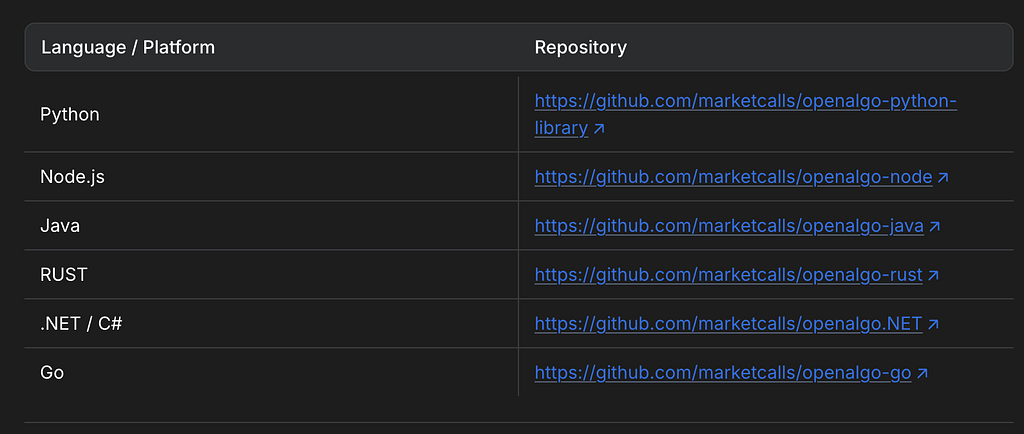
This means you can write strategies in the language you prefer and target multiple brokers without building integrations from scratch. That capability saves time and allows you to move between brokers without rewriting your entire system.
A few milliseconds of overhead is small compared to the time saved when you do not need to rebuild your trading infrastructure every time you switch providers.
So what is the truth traders should know
Language speed helps, but does not break the biggest delay
Desktop applications are not automatically more robust
The internet is not consistent enough for true high frequency trading
Broker round trip latency is measured in tens of milliseconds
Actual high frequency trading is measured in microseconds and nanoseconds
Consistency requires colocating near exchanges, not sitting behind a home connection
And most importantly A multi language SDK ecosystem gives more real world advantages than shaving a few milliseconds off local processing
The misconception resolved
Speed matters, but it is not where most traders think it is.
Consistency matters, but you do not get it over the public internet.
Robustness matters, but it is a property of system design, not the application type.
And flexibility matters, because strategies grow over years, not days.
The right foundation makes your trading platform durable.
OpenAlgo gives that foundation through consistent broker access and ready to use SDKs in the languages traders want to build with, which many brokers do not offer at all.
